> ## Documentation Index
> Fetch the complete documentation index at: https://docs.landerlab.io/llms.txt
> Use this file to discover all available pages before exploring further.
# Layout Settings for Element Alignment and Spacing
> Control layout settings to align elements, manage spacing, and create clean, responsive landing page designs with ease.
The Layout settings control **how elements are arranged inside a container**.\
This is where you decide if items go **side by side, stacked, centered, spaced, etc.**
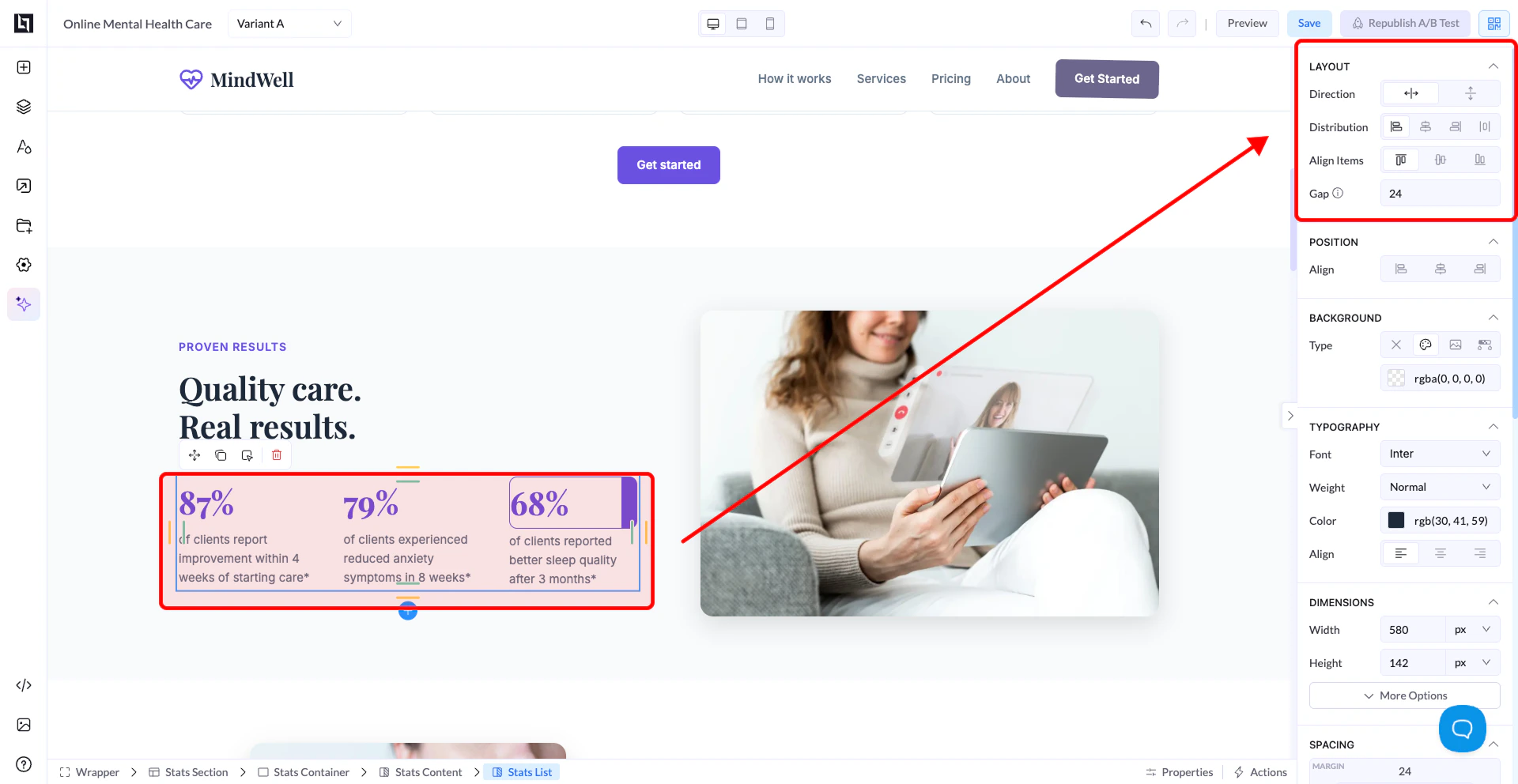 ## The 4 Key Settings
## 1. Direction (Most Important)
This controls **how items are placed inside the container**.
### Horizontal (Row)
* Elements go **left → right**
* Example: buttons next to each other
👉 Use this for:
* Rows
* Inline elements
* Columns side by side
### Vertical (Column)
* Elements go **top → bottom**
* Example: title → text → button
👉 Use this for:
* Forms
* Stacked content
* Most layouts (default)
If something is not aligning correctly, check Direction first — this is the #1 issue users face.
***
## 2. Distribution (Spacing Between Items)
This controls **how items are spaced across the container**.
Common options:
* **Start** → items stick to the beginning
* **Center** → items stay in the middle
* **End** → items go to the end
* **Space Between** → first left, last right, space in between
* **Space Around** → equal space around items
***
👉 Example:
If you have 3 buttons:
* Space Between → spread across full width
* Center → grouped in the middle
***
## 3. Align Items (Alignment)
This controls alignment on the **opposite axis of Direction**.
### If Direction = Row (horizontal):
* Align Items = vertical alignment
* Top
* Center
* Bottom
***
### If Direction = Column (vertical):
* Align Items = horizontal alignment
* Left
* Center
* Right
**Important:**
* Direction = main axis
* Align Items = cross axis
(This is where most confusion happens)
***
## 4. Gap
* Controls space **between elements**
* Works like automatic spacing
👉 Example:
* Gap = 20 → adds equal spacing between all items
***
# Simple Examples
### Example 1: Center everything
* Direction: Vertical
* Align Items: Center
* Distribution: Center
👉 Result: everything perfectly centered
***
### Example 2: Buttons in a row
* Direction: Horizontal
* Distribution: Space Between
* Align Items: Center
👉 Result: buttons spread across horizontally
***
### Example 3: Simple form layout
* Direction: Vertical
* Align Items: Left
* Gap: 10–20
👉 Result: clean vertical form
***
## Common Mistakes
❌ Trying to center elements without changing Direction\
❌ Confusing Align Items with Distribution\
❌ Adding margin instead of using Gap\
❌ Forgetting container controls child elements
***
## Best Practices
* Start with **Column** for most layouts
* Use **Row only when needed**
* Use **Gap instead of manual spacing**
* Keep layouts simple and consistent
**Golden Rule:**\
If something looks “wrong”, it’s almost always:
* Wrong Direction
* Wrong Alignment
## The 4 Key Settings
## 1. Direction (Most Important)
This controls **how items are placed inside the container**.
### Horizontal (Row)
* Elements go **left → right**
* Example: buttons next to each other
👉 Use this for:
* Rows
* Inline elements
* Columns side by side
### Vertical (Column)
* Elements go **top → bottom**
* Example: title → text → button
👉 Use this for:
* Forms
* Stacked content
* Most layouts (default)
If something is not aligning correctly, check Direction first — this is the #1 issue users face.
***
## 2. Distribution (Spacing Between Items)
This controls **how items are spaced across the container**.
Common options:
* **Start** → items stick to the beginning
* **Center** → items stay in the middle
* **End** → items go to the end
* **Space Between** → first left, last right, space in between
* **Space Around** → equal space around items
***
👉 Example:
If you have 3 buttons:
* Space Between → spread across full width
* Center → grouped in the middle
***
## 3. Align Items (Alignment)
This controls alignment on the **opposite axis of Direction**.
### If Direction = Row (horizontal):
* Align Items = vertical alignment
* Top
* Center
* Bottom
***
### If Direction = Column (vertical):
* Align Items = horizontal alignment
* Left
* Center
* Right
**Important:**
* Direction = main axis
* Align Items = cross axis
(This is where most confusion happens)
***
## 4. Gap
* Controls space **between elements**
* Works like automatic spacing
👉 Example:
* Gap = 20 → adds equal spacing between all items
***
# Simple Examples
### Example 1: Center everything
* Direction: Vertical
* Align Items: Center
* Distribution: Center
👉 Result: everything perfectly centered
***
### Example 2: Buttons in a row
* Direction: Horizontal
* Distribution: Space Between
* Align Items: Center
👉 Result: buttons spread across horizontally
***
### Example 3: Simple form layout
* Direction: Vertical
* Align Items: Left
* Gap: 10–20
👉 Result: clean vertical form
***
## Common Mistakes
❌ Trying to center elements without changing Direction\
❌ Confusing Align Items with Distribution\
❌ Adding margin instead of using Gap\
❌ Forgetting container controls child elements
***
## Best Practices
* Start with **Column** for most layouts
* Use **Row only when needed**
* Use **Gap instead of manual spacing**
* Keep layouts simple and consistent
**Golden Rule:**\
If something looks “wrong”, it’s almost always:
* Wrong Direction
* Wrong Alignment